
A basketball player doesn’t spend 25 minutes on free throws and then move on to the next thing. They shoot jump shots, dribble, run laps, and then go back to free throws. They’re constantly switching, because that’s what makes the learning much more durable.
Most of us do the opposite. You play something short 6 times and it’s in your short-term memory. The next 694 repetitions don’t add anything.
Pianists can and should switch the way a basketball player does. It’s called interleaved practice.
What interleaved practice is
You work on one thing for a little while, and then you switch to something else. Then you come back. The “something else” can be the next chunk of your piece, a different passage, or a different piece entirely.
It can feel less smooth than playing one passage over and over. That’s the point. Each time you come back, your brain has to retrieve what you just learned. The retrieving will feel more difficult than repeating something that’s already in short term memory.
Why it works
What makes you learn is putting it into short-term memory, forgetting a little, and putting it back again.
Breaks help too. You don’t actually get better while you’re playing. You get better while you’re resting. When you stop and don’t think about it, your brain keeps rehearsing what you just did. Sleep does it too, and so does a day off from a passage. You might come back from a weekend away and find the piece is better than when you left.
I’ve also seen that the students who learn the most pieces get better the fastest. Each new piece gives your brain more examples of the same ideas. That’s a good reason to care about how to speed up your learning.
4 ways to practice this way
Chapter 7 of Dr. Molly Gebrian’s recent book Learn Faster, Perform Better recommends these for performance prep, and I’ve found them insanely helpful:
1. Make a list of your difficult spots. Include every place you’ve messed up or worry about. Keep each one small, 1 to 2 measures.
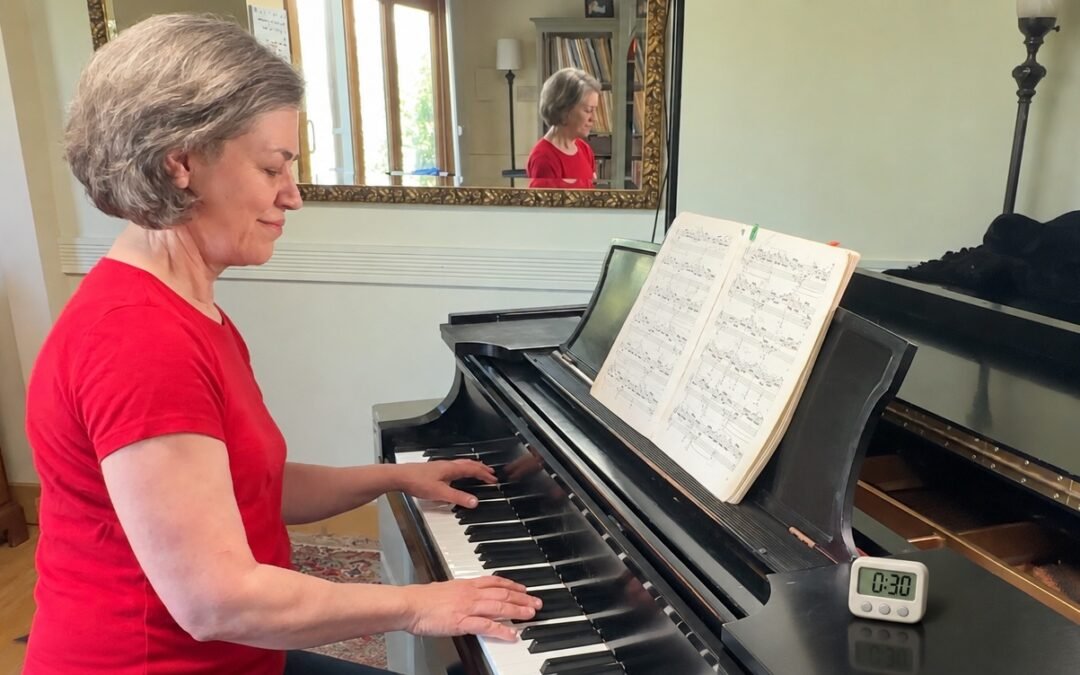
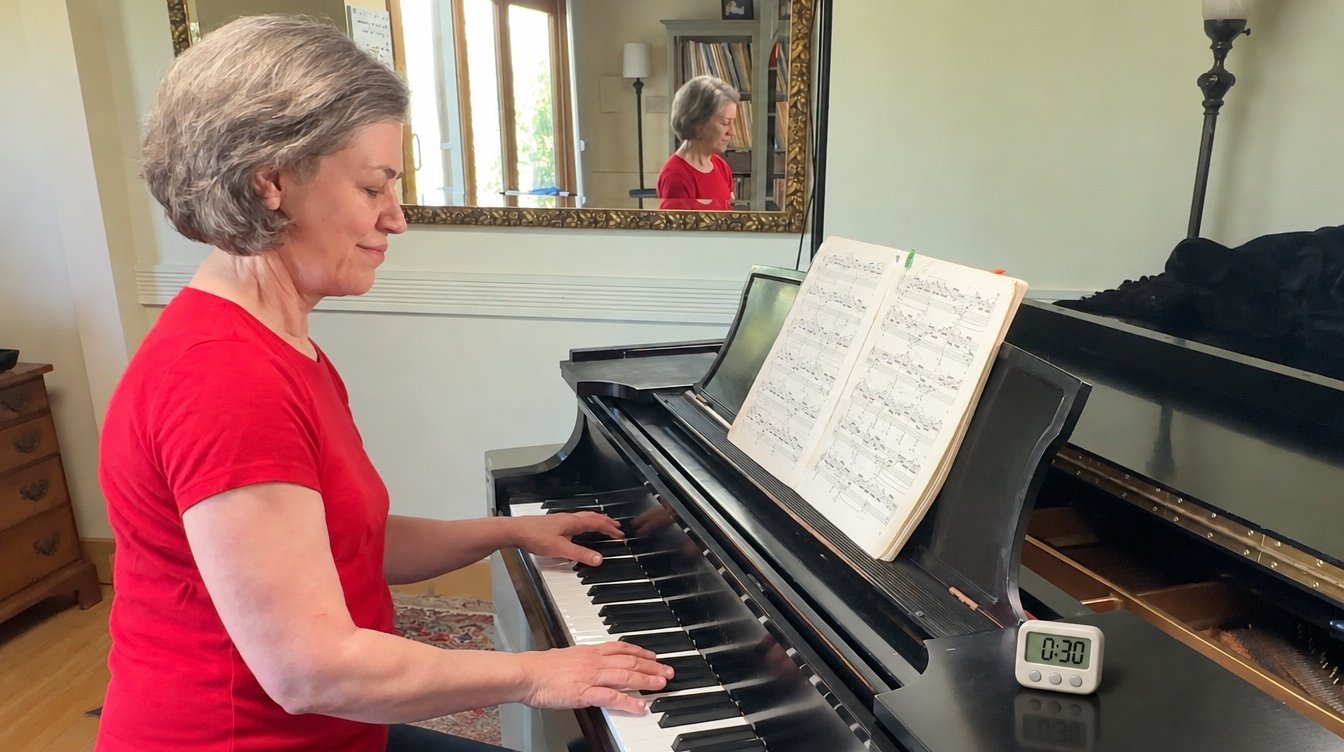
2. Use an interval timer. Set it for 3 to 5 minutes. Work hard on one spot until it rings, then switch right away to another, even before you feel finished. Walking away unfinished can get you where you want to go faster.
3. Play the spots in random order. I use the Google random number generator. It keeps you from leaning on muscle memory, and it trains you to start confidently from anywhere. If you make a mistake, keep going. That trains your brain not to spiral.
4. Do one-shot run-throughs. Pick a hard spot, pretend you’re on stage, and play it once with full concentration. Then stop and evaluate. It should feel like your only shot.
In her class for my community, Piano with Rebecca B, Molly shared that she is now doing 1 mental repetition, then 1 physical repetition, then a break. Even the experts keep refining their approach.
Easy ways to make it stick
- Don’t repeat mindlessly. If you make a mistake, stop and ask why. Was it the fingering? Where was your arm? Did your mind wander?
- Take a 5 to 10 second break between sets. Play a tiny chunk 3 times, rest 5 to 10 seconds, then play it 3 more times. Then move on.
- Bookmark your hotspots. L., a member, saves her difficult passages as ForScore bookmarks and flips between them: “Flipping between my bookmarks makes for nice interleaving.”
What it does for members
J., a member, wrote: “With this interleaving practice, learning is faster.” She also comes from a background of performance trauma, and she wrote that nothing began to break through that until she started practicing this way.
Where interleaved clicking up fits
There’s a speed tool built on this idea. It’s called interleaved clicking up, and it breaks a passage into chunks and rotates them while the tempo zigzags up. I wrote it up here: Interleaved Clicking Up: Play Piano Passages Faster. Pair it with the chunking idea in Chunking: Why Small Sections Learn Faster.
If you’d like help applying this to your own pieces, I teach it inside my community. You can start with my free guide to turbocharge your practicing: https://learn.rebeccabogartpiano.com/turbocharge
Write your list, set the timer, and switch before you feel finished. Which spot in your piece goes on the list first? Tell me in the comments.
Happy practicing,
Rebecca