
I worked on Chopin’s 4th Scherzo for several years, trying to increase my speed. Then I tried interleaved clicking up. In just 4 to 5 weeks, I sped up the hardest parts by about 15%. I couldn’t believe it. The gains seem to stick, too.
Watch me play the coda: Is Chopin Scherzo No 4 Coda the Key to Unlocking Your Piano Potential? (starts at 2:19).
Why a slow passage stays slow
Maybe your notes are solid and the passage feels easy and effortless, and it still won’t go fast. After years of practicing it slowly most of the time, my mind couldn’t go as fast as it needed to. The problem was not physical; it was mental.
Interleaved clicking up teaches your brain how to think at the faster speed. That is a different job from fixing tension, choreography or body alignment. It needs its own practice.
What it is
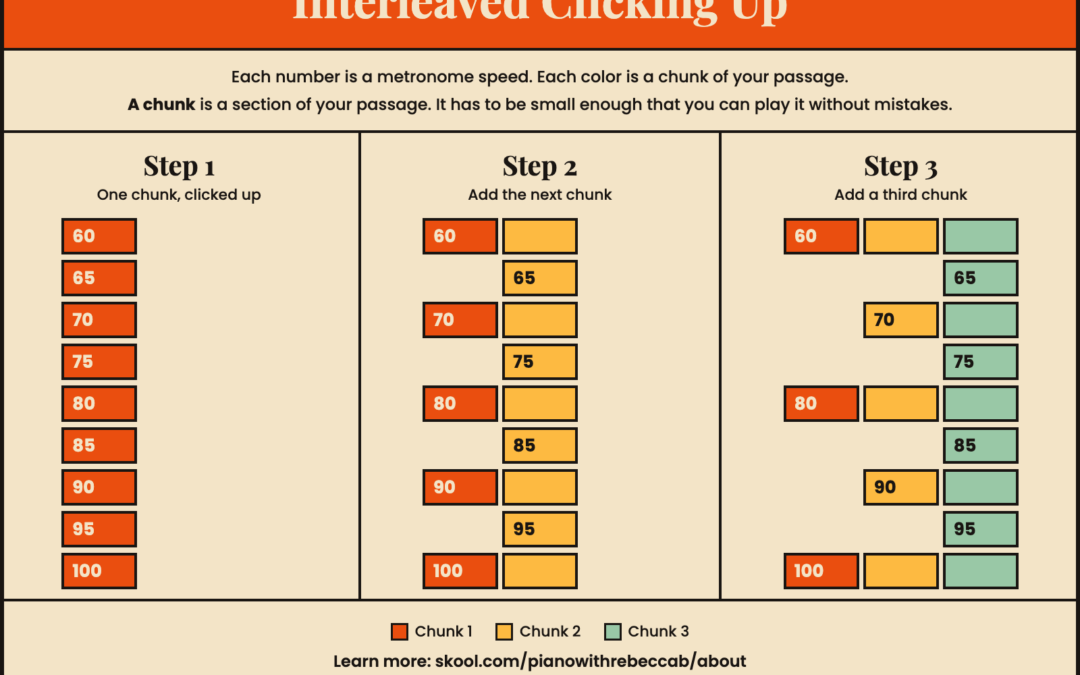
Plain clicking up means raising the metronome a notch at a time. The interleaved version comes from Dr. Molly Gebrian. You break the passage into chunks and click them up in a rotating pattern.
A chunk is a section of your passage. It has to be small enough that you can play it without mistakes. You start with a single chunk and click it up. Then you add another chunk, and you play sections of different lengths each time you raise the speed.
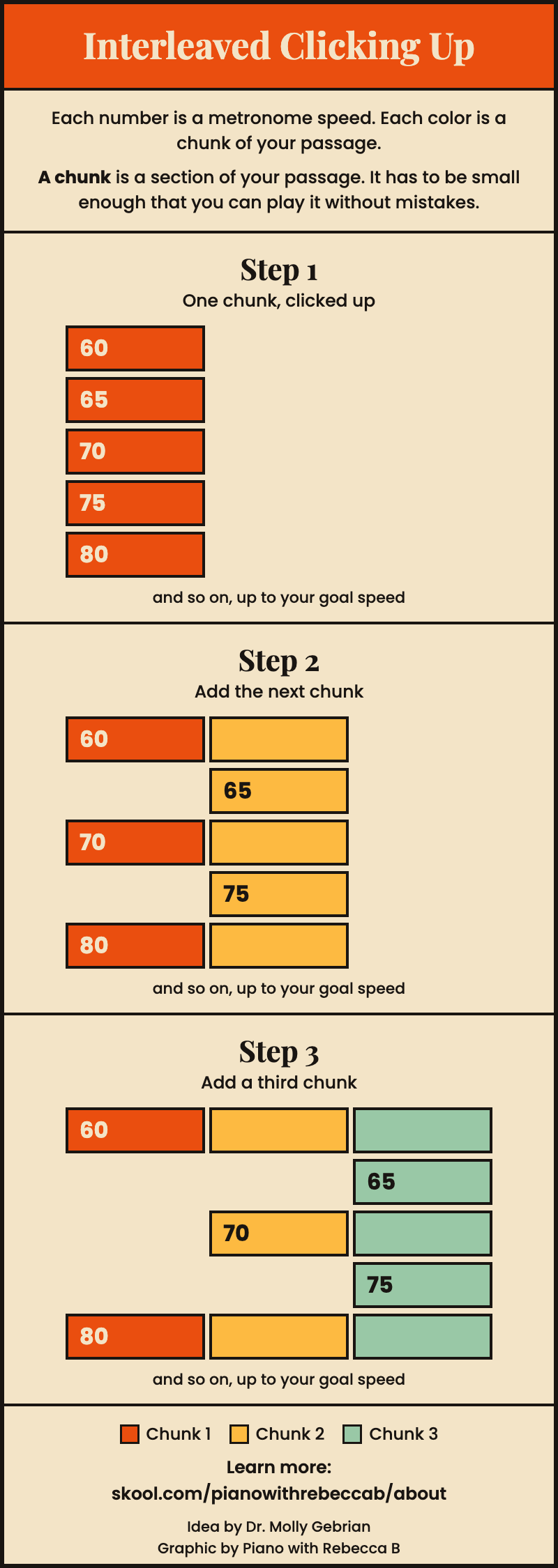
Idea by Dr. Molly Gebrian. She explains it in How To Practice to Increase Speed: Part II and demonstrates it in Part III. I use the metronome mostly for this now. I increase my speed much faster with the interleaved version than with the steady click.
You might not remember the pattern. That’s normal.
I can’t keep the rotation in my head either. Besides, I want to devote my mental resources to practicing, not keeping track of the pattern. I need either the picture or Interleaved Clicking Up Calculator.
One member of Piano with Rebecca B said the tool looked “beyond my comprehension” at first, so she watched Dr. Gebrian’s video. Then it made sense.
This Interleaved Clicking Up free calculator does the tracking for you. One of my members likes that it’s “set it and forget it” compared with fiddling with a digital metronome. Pick your goal tempo, and it tells you what to play and how fast.
If your passage has a lot of leaps
If your passage has a lot of leaps that aren’t completely learned in your hands, interleaved clicking up will not work yet. Practice each leap as its own chunk first. I show how in my video, The Real Reason You Keep Missing Piano Jumps.
It takes time
J., a member, tried it on 2 measures. He split them into 8 beats and stepped through 7 tempos. That’s 56 different practice settings, and it took him over an hour. N. worked through 20 measures in groups of 4, and that took almost an hour too.
My answer: “Definitely time consuming. On the other hand, highly effective.” So you spend a lot of time on speeding up a passage for a few days, maybe a week. Then the tempo gains stick. Start with a small section, and let your mind rest every minute or so for 5 to 10 seconds. It looks like nothing is happening. A lot is.
When a chunk falls apart
- Don’t practice mistakes. Do whatever you need to so you aren’t playing it wrong.
- Repeat a chunk if it went badly. I sometimes replay it at the same tempo before moving on.
- Check your fingering and movement. Weak spots often come from a fingering or a movement that isn’t working. You won’t be able to speed up until you solve whatever the issue is. A. found just that: “it was a fingering that was causing the problem.”
- Go smaller. Try really small chunks at your goal tempo to see whether your choreography is doable. (More in Chunking: Why Small Sections Learn Faster.)
- Picture it easy. Some days I can’t speed up past a point until I find what I’m doing physically that holds me back. If I can’t find it, I imagine myself playing it with lots of ease and speed. That worked fantastically well on Chopin’s Impromptu #1.
What a week looked like for one member
B. wanted to play the first Philip Glass Etude. The notes came easily, but the tempo was out of reach. His words: “By interleaving and using metronome clicking throughout the week, I arrived at the (goal)metronome mark today.”
Try it on one passage
Pick a passage where the notes are secure and the tempo isn’t what you would like. Do a small section today. Then see what happens in the next 4 to 5 weeks.
I teach this inside my community, with videos and live Q and A, so you can ask about your own piece. You can start with my free guide to turbocharge your practicing: https://learn.rebeccabogartpiano.com/turbocharge
Which passage of yours has been stuck at the same tempo the longest? Tell me in the comments.
Happy practicing,
Rebecca