
Sore wrists or achy hands usually start before your fingers touch a key. Your fingers curl and grip just to hold on. Your hands spend a lot of time in awkward positions. That gripping and twisting is the ache you feel later.
Strengthening your fingers, and/or trying to relax will not address the problem if you are using your body in ways that put it under a lot of strain.
Tension and fatigue come before pain and injury. If you feel either one, that’s your signal to change something. They are not inevitable, and gritting your teeth through them is not the answer.
You’ll only play with ease when you learn to make the most efficient, minimal movements. Think of an Olympic runner. They don’t train in combat boots. They perfect their form and wear the best running shoes they can find.
That’s why the common response of practicing harder is a bad idea. That road can lead to a more serious injury. You could need a long stretch of resting your hands instead of playing. Every repetition also could be baking in movements and alignment that make playing more difficult and uncomfortable.
Also unlearning is much harder than learning. Often it’s easier to give up on a piece with tension and struggle baked in and start something new. So practicing harder with troublesome movements takes you further away from playing the music you love with comfort and ease.
The fix is usually in how you sit and move. Ann Marie, a piano teacher herself, changed how she sat and “noticed better sound and ease of playing right away.” Start with these five checks.
1. Check your bench height
If the bench is too low, your wrist drops below the keys. Then your fingers have to grip to keep your hands from falling off the keys. Your shoulders might also creep up in an attempt to get your hands at the right level. What’s next? Sore neck and back.
Fiona, a member of my community, raised her seat about 2 inches. Her words: “I feel as if I’m playing a different instrument – my back and shoulders feel different and better.”
2. Check your distance from the keyboard
Sitting too close jams your elbows into your sides, with no room for your arm to travel.
Sit far enough back that your arm has space in front of you. Kathy found that keeping “an arms’ length from the keyboard” immediately fixed her trouble reaching the whole keyboard. Sit toward the front of the bench too, not settled back. This makes it easier for your torso to move and be properly balanced over your sit bones. It might feel strange at first.
3. Find your wrist height with 1 note
Play 1 note over and over, as fast as you comfortably can, with one finger. While you repeat it, try different wrist heights. One height will suddenly feel easy.
- Wrist too low: fingers grip to hold on.
- Wrist too high: your arm weight can’t reach the keys, and playing feels disconnected.
- In between: weight flows from your arm, through a level wrist, into your hand.
Remember that feeling and bring it back to your pieces.
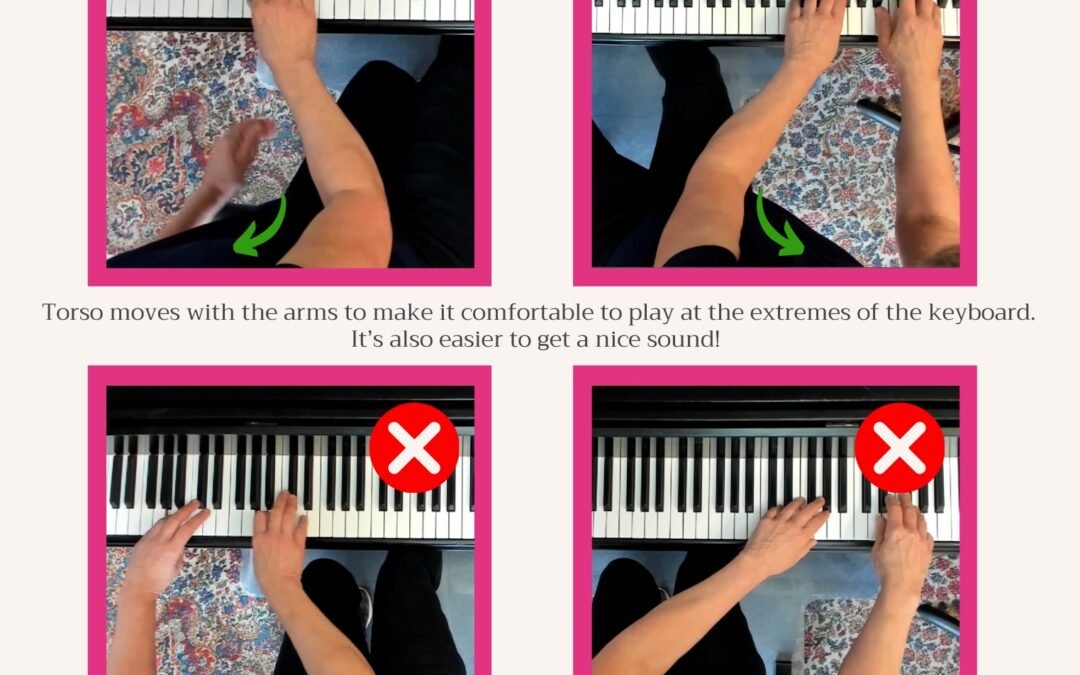
4. Move your elbow and body, not your wrist
When a note is hard to reach, the habit is to twist the wrist toward the note. Do the opposite. Lean back or away a little, and let your elbow come in front of you.
Keep the elbow centered in the middle of the notes you’re playing, like a windshield wiper. As you travel up or down the keyboard, move your whole torso with you. Ken noticed this right away: when he leaned a bit instead of reaching his arm out, the passage got easier.
5. Check your head and shoulders
The human head is very heavy. If your head droops forward toward the music, it creates tension down through your shoulders, arms and hands before you notice. Engage your core slightly, the way you would to lift something heavy, and let your shoulders relax.
Start before you play
Before you play a passage that is tense or uncomfortable again, run these five checks. Pain that happens every time you play, is worth showing to someone experienced with healing musician’s injuries.
The fix starts before your fingers touch a key. The Pianist’s Body Blueprint shows you where to sit and how to move, in clear photos and short videos: bench height, distance, hand and arm angle, elbow and foot. The guide is $14, built to stop pain before it starts. Get the Body Blueprint →