
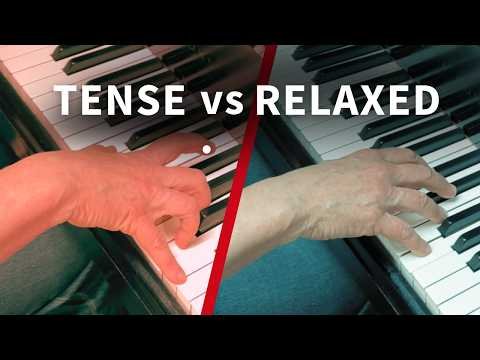
1. Hanging on to notes that are already finished
These three habits are the same ones I demonstrate on camera in The 4 Reasons Your Hands Get Tense (You Don’t Know You’re Doing #3). Watching the movement helps more than reading about it, so start there if you learn better by seeing it.
Watch your hand on a passage you know well. Often a finger is still pressing down on a key after the note is supposed to be over. It’s not necessary, and you cannot hear it either. You can only feel it, as tension building in the hand.
The fix: the instant you no longer need a note, release the key and release the hand with it. Same notes, but the hand empties out between keys instead of staying braced. Players who make this change usually get a clearer sound. Many can play faster too, because they have less tension. Also the arm can adjust behind every key so if you are playing a fast passage moving in one direction your movement will be smoother.
2. Holding a stretch open instead of passing through it
A common habit, when a passage has big intervals is opening the hand sideways to get across a distance. Then staying there, held open, while the music keeps going. That held-open position gets tiring fast. It is also often where the sound starts to turn harsh.
The fix: do not hold the distance with your fingers. Keep the hand more together. Let the forearm carry you to the next position. The stretch is a moment you pass through, not a place you live.
3. Turning too far toward the pinky side
The medical name is ulnar deviation, turning the hand toward the ulna, the bone on the pinky side. A little of this motion is normal. Doing it often, at the extreme end of the range, is a known risk factor for tension and injury.
The most common trigger is reaching for the thumb, especially when the thumb has to land in front of the body in the middle of the keyboard. Another very common trigger is when the thumb needs to play a black key. The habit is a big turn of the whole hand to get there.
The fix is two fold.
1. For passages in front of the body, make sure you are sitting far enough away that you can get your elbow comfortably behind whatever notes you need to play without having to turn at the wrist.
2. When you have to play a thumb on a black key, bring the whole hand into the black keys a note or two earlier so you are not lunging at the last minute.
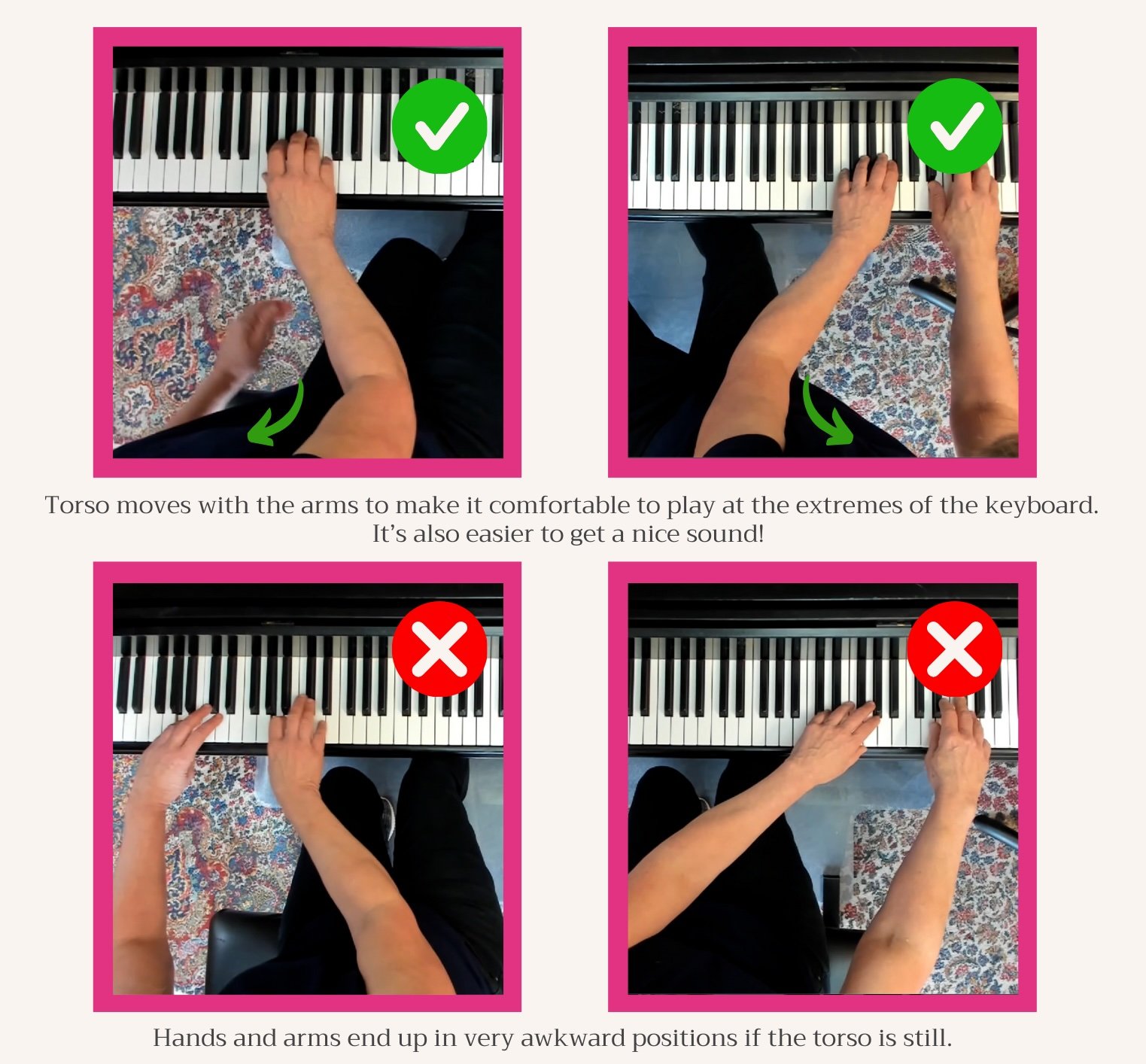
A passage that still forces a big turn probably needs a different fingering, or a small shift of your whole body instead of more twist at the wrist.
The pattern underneath all three
Each habit is the hand trying to solve a problem the arm, elbow, or body should be solving instead. Let go when you no longer need a note. Let the forearm do the traveling. Move your elbow and your body, not just your wrist. One member found this out by accident: leaning slightly differently at the keyboard turned a passage that had been a fight into one that suddenly felt easy.
The full picture, hand position, distance from the piano, posture, and how they work together, is exactly what the Pianist’s Body Blueprint covers. A $14 guide built to stop tension before it starts. Get the Body Blueprint →