
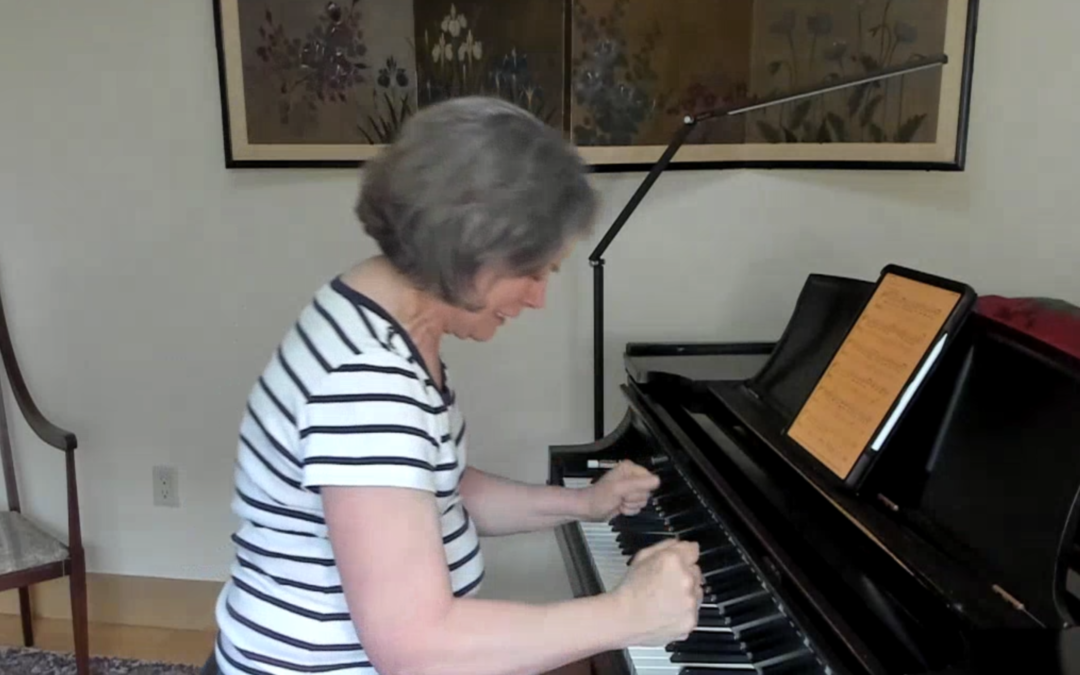
Do you ever want to pound the keys and scream? When you’re stuck, frustration is the right response.
You may have been told to just try not to get frustrated. And when you do, you may decide something is wrong with you. It isn’t. Frustration isn’t what holds you back. What you do next is what matters.
How frustration shows up
- You repeat a passage that isn’t improving, hoping it will eventually click.
- A practice session ends with no sense of progress at all.
- You come back the next day and what was solid yesterday has vanished.
- You wander off into a piece you’ve already mastered, or start sight reading.
- The sewer thoughts arrive: “I’m terrible at this. There’s something wrong with me.”
- You avoid the piano completely. Or you do what I did, and push so hard you injure yourself.
Every one of these is a signal, not a character flaw.
The 4 things frustration usually means
In my 50 years of teaching, it’s almost always one of these. Once you know them, frustration stops feeling like stormy weather. It’s more like a notification on your phone: something to read, not something to survive.
1. The section is too long. This is by far the most common. A student of mine was very frustrated with a cadenza in Liszt’s Liebestraum. She was practicing it in one long stretch. I broke it into two sections, then joined them once each one was easy. Shrink the task until it’s learnable, then build from there.
Martha S., an accompanist in my community, describes the relief: “I know some very good approaches now to unpack difficult sections, and I’m not beating myself up for not being immediately genius.”
2. The fingering won’t work. No number of repetitions will fix a fingering that doesn’t fit your hand or your brain. Maybe your hand is too crowded or too stretched out. Maybe getting in and out of the black keys is the trouble.
3. The movement isn’t in your body yet. Your hand doesn’t know how to make the motion at speed, or doesn’t know what the motion is. Repetition alone won’t fix that. Work out what the movement should be, then teach it to yourself in bite-sized chunks.
4. The piece is too hard for you right now. The section is small, the fingering is right, you’re working carefully on the movement, and you’re still frustrated? Give it a rest. It could be 5 minutes or 5 years. That’s not failure, that’s wisdom. My dad always said, “Discretion is the better part of valor.” Put the piece back on the shelf and come back when you’re ready to blast through it.
A word I love here is “doablizing.” Micah Killian coined it, and I heard it on the Bulletproof Musician podcast. It means adjusting what you’re working on until it sits right at the edge of what you can do. Not so easy you’re bored, not so hard it’s impossible. That edge is where the learning happens.
Serious pianists practice more carefully, not less
Most people assume advanced pianists sit down and learn hard pieces in a few days. So when your practice is full of false starts, it’s easy to think you’re the problem.
Steph Curry is one of the greatest shooters in NBA history. He’s famous for spending hours every day practicing basic dribbling and shooting. Advanced means more deliberate, not less. Advanced players have mastered the skill of practicing.
Stopping is a power move
When you’re emotionally overwhelmed at the piano, the most effective thing to do is stop. Don’t grind. Put your hands at your sides and back away slowly.
I do this outside the piano too. I’m learning online marketing right now, and sometimes I get so worked up I can’t think about it anymore. Then I go for a walk or play with my cats, and come back when I feel open to something difficult again.
Intense emotions hijack your attention and your working memory, and you need both to learn. You have to notice what you did, compare it with what you meant, and adjust. A head full of “I hate this” has no room left for that. Breaks also speed up learning, so let the break do some of the work for you.
I also don’t want to link the piano with feeling terrible. It’s hard enough as it is.
Stop comparing yourself to recordings
A recording is a performer’s best take of a piece they spent months or years learning, maybe edited, always beautifully produced. Nobody films the slow fragments played over and over before it.
Psychologists call this compare and despair. Pianists are especially open to it, because we can compare ourselves to everyone recorded since the late 1890s. Horowitz, Argerich, Cortot, on demand. What chance does your Tuesday afternoon session have?
At the conservatory I played regularly for a group of four or five other pianists. That group showed me how long things really take. My community members tell me the same thing about playing alongside other pianists now. Claire B. put it this way after watching my own behind-the-scenes practice: she could “take heart that it is a layered process for everyone and I don’t have to compare my own modest efforts negatively.”
If you don’t have that company yet, go find it: a class run by your teacher, an online group, a pianist friend.
Forget the finish line
Researchers at Stanford studied young children who drew for fun. Once the kids got rewards for drawing, they stopped drawing for fun. When the reward went away, so did the motivation.
The same thing can happen at the piano. “When I finish this piece, I’ll finally feel like a real pianist.” Every day before that becomes something to get through. When you learn to value the work itself, the beauty of one chord or a sudden insight into a phrase, where you are today stops being a problem. The breakthroughs often come faster once they aren’t the main point.
Why fixing a habit feels worse first
Fixing a bad habit is much harder than learning something new, and it will feel worse before it feels better. The old habit doesn’t disappear. Your brain will run it automatically when you’re stressed, playing fast or tired.
So fixing it means three things happening at once. Interrupt the old response every time it fires. Build the new one. Repeat until the new one is easier than the old. That’s why “just stop doing that” is terrible teaching.
I know this firsthand. For my Carnegie Hall recital, I had carefully changed which octave I used for one bass note. Under pressure, my hand went straight back to the old habit. That was the only mistake I made all night, so I was thrilled. Two takeaways: expect the dip, because it means change is happening. And don’t try to fix a habit close to a performance.
Nelda M. said of this teaching: “It was not only very encouraging for piano frustrations but also for a lot of life frustrations as well.”
Watch the full video: How Serious Pianists Handle Practice Frustration.
Want company on the journey and a step-by-step way to practice your own pieces? Start with the 28-Day Piano Journey inside Piano with Rebecca B. Start your 7-day free trial.