
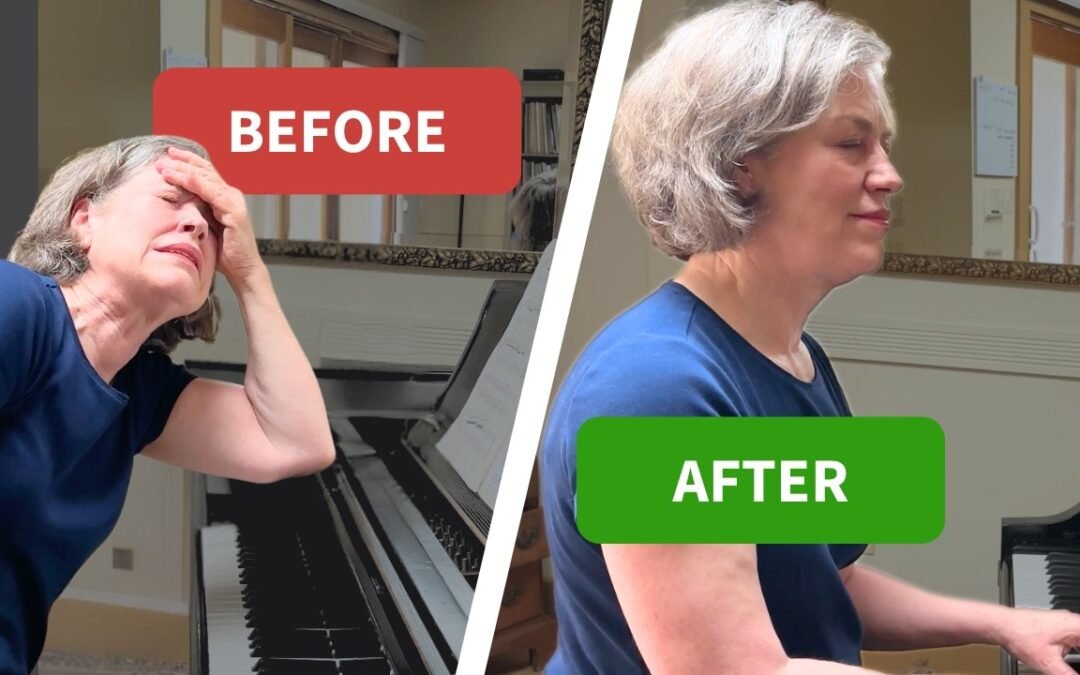
If you practice for an hour and the next day it feels like you forgot everything, the piece is not too hard for you. The way you are practicing it is the problem. These are the seven steps I use with my students, shown with Debussy's Clair de Lune. You can watch me demonstrate all of them in I'd Learn New Pieces Faster if I'd Known These 7 Steps Earlier.
1. Map the structure first
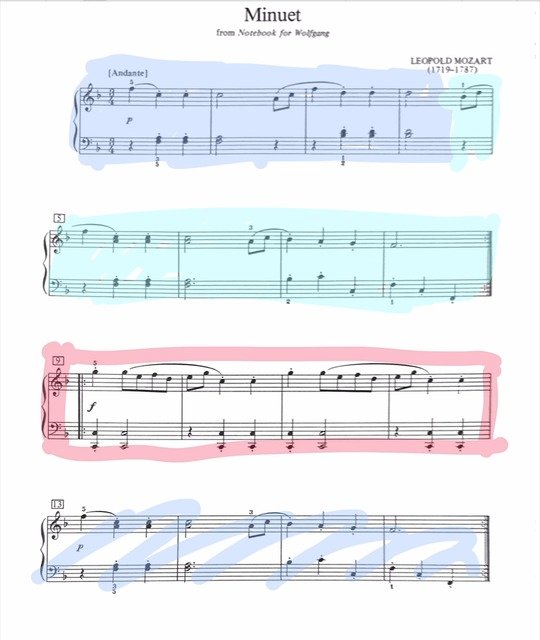
Your brain will not absorb a forest of notes. It will learn a map. Before you play much at all, mark the big sections. I like to colorcode them using the forScore app, but it doesn't matter exactly how you do it.
Mark anything that repeats; I just use the same color for every repeat of an idea.
Then mark the parts that you think will be the hardest. I put a red box around them. If they are only moderately difficult I use a yellow box. (Like traffic lights).
2. Plan your fingering before you repeat anything
Practice a spot with three different fingerings and you have learned three different movement patterns. Under pressure your hands pick one at random. That is the source of "random" mistakes. My rule is one passage, one fingering plan. Scan the whole piece once and pencil in fingerings wherever the hand position changes or you find yourself unsure of what finger to use. Be sure you've finished planning a fingering for every note of a passage before you start working on it.
You can always change the fingerings later, if needed. But it's better to start with a plan than a grab bag.
3. Start with the hard parts
Leave the hardest section for last and it ends up holding the rest of the piece hostage. It is like cooking for a dinner party. You don't make the salad first and throw the roast in 10 minutes before the guests arrive. In Clair de Lune I would start with measures 41 and 42, and 45 and 46.
4. Build chunks that stick
Pick a chunk small enough to play perfectly. That might be one beat, two beats, or a bar if it is not too hard. Use a tempo with no mistakes. Play it three times, take a short break, then three more times, with the same fingering and the same movements every time. Each time, play a little past the edge into the next chunk.
If you are still making mistakes, the chunk is too long or the tempo is too fast. And if you get bored, that is usually your brain saying it has absorbed all it can on this part and is ready to move on.
5. Join chunks across the seams
Once a chunk is solid on the first try of the day, stop repeating it and connect it to the next one. Practice the seam: a couple of beats before the join and a couple of beats after.
6. Add musicality from day one
Pick two recordings you love and listen twice. The first time, listen for where the music gets louder and softer. The second time, listen for where it pushes ahead or pulls back. Mark both in your score, then play as much of that as you can right now, even if it is only the melody louder than the accompaniment. It also helps to sing the melody while you learn it.
7. Use the right tool for the problem
A spot that stays messy for weeks usually needs a different tool, not more repetitions.
- Rhythm: say it before you play it, one rhythm word per pulse. Your voice leads and your fingers follow.
- Leaps: get to the new note early, land on it, then play.
- Speed: instead of creeping up the metronome, practice tiny sections at or above your goal tempo, overlapping into the next section.
Want help doing this every day?
Knowing the steps and building them into your practice are two different things. The 28 Day Piano Journey gives you a short teaching video each day. You can also ask me about your own piece. Jan, a member, wrote on day 17: "I can already now say that I'm definitely learning faster! And with much less trouble and frustrations."
There is a 7-day free trial. Start the 28 Day Piano Journey